Review: ‘Bocking’ Is Bold, Funny and Provocative — Sometimes to a Fault
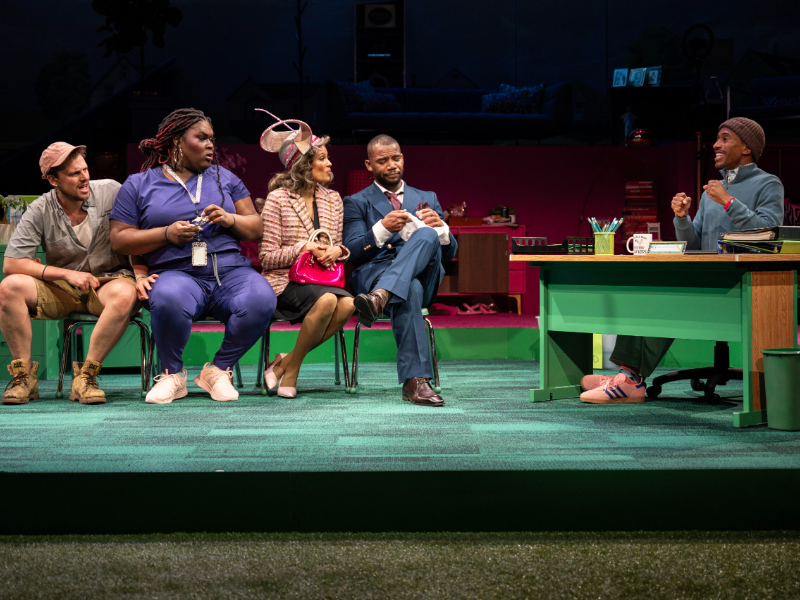
Harold BookerBocking, now making its world premiere at Baltimore Center Stage, is bold, explicit, funny and determined to make audiences uncomfortable. Written by Preston Crowder and directed by Stevie Walker-Webb, the approximately 90-minute comedy explores sexuality, religion, family, childhood trauma and desire through a distinctly Black and queer lens.
The story centers on two very different families who are forced together after their children repeat inappropriate phrases at school that they apparently overheard at home. What begins as an awkward meeting between parents opens the door to revelations about marriage, sexuality, shame and unresolved trauma.
From its opening moments, Bocking makes clear that little is off limits. The production contains extensive profanity, graphic sexual references, fetish practices, religious satire and deliberately outrageous humor. During a conversation surrounding the premiere, producer Lena Waithe asked Crowder how many people he hoped would walk out. His response was essentially: a lot. That desire to provoke is embedded in the play’s DNA.
The cast approaches the material fearlessly.
Rebecca L. Hargrove is one of the production’s great comic pleasures. Her physical comedy is precise, her timing impeccable and her presence consistently commanding. Learning that Hargrove is also a two-time Grammy Award-winning opera singer makes her range even more impressive. Costume designer Orla Long complements that performance with authentic First Lady ensembles, particularly a procession of elaborate church hats that nearly become characters themselves. Each time one disappeared, the audience seemed eager to see what would come next.
Kalen Allen, widely known for his work on The Ellen DeGeneres Show, is funny, assured and nuanced. His character raises an interesting question about the assumptions people make when someone appears queer, even if that person’s experiences do not necessarily fit the identity others have assigned to them.
Sis Thee Doll brings both tenderness and sharp comedic timing, while Blake Morris, as Javon Wing, gives one of the production’s strongest dramatic performances. Morris brings gravity and tension to complicated revelations without overplaying them.
Christopher Sears is fearless as Pierre Day. As the sole white character in a predominantly Black ensemble, Pierre bears the brunt of many of the racial jokes, and Sears takes them in stride while fitting naturally into the cast. His role as a cisgender queer husband in an interracial marriage adds another layer to the play’s exploration of sexuality and relationships. During the exorcism scene, Sears goes all in, fully committing to the physical comedy.
Adrienne C. Moore is the standout. Best known to many audiences as Black Cindy on Orange Is the New Black, Moore is magnetic, hilarious and essential to the production’s success. As the pesky friend who always seems to be in everyone’s business, she could have remained comic relief. Instead, Moore gives the character dimension and ultimately becomes central to resolving the story.
Walker-Webb’s direction continues the artistic vision he has brought to Baltimore Center Stage: creating space for ambitious Black work that is allowed to be messy, unconventional and unapologetic. Bocking benefits from that freedom.
The play itself, however, is not equally successful in every choice. Some storylines feel provocative simply for the sake of provocation rather than because they are necessary to the story. The shock often generates laughter, but there are moments when the play appears more interested in testing the audience’s limits than deepening its characters.
That weakness is especially noticeable in its recurring use of chicken. Chicken is positioned as a central cultural and comedic motif, seemingly intended to say something larger about Blackness, stereotype and identity. Yet the idea never feels fully developed. At times, the trope becomes an easy comedic shortcut rather than something the play meaningfully interrogates.
Still, Bocking feels uniquely suited to Baltimore. After the performance, over a crab cake at Coco’s Pub, friends and I discussed how naturally the play fits this city despite being set in a fictitious Tennessee town. It is unapologetically Black, Southern in its cultural sensibility, deeply rooted in church life and unmistakably queer.
Baltimore is a city where those identities regularly coexist in the same neighborhoods, families, congregations and people. That makes it an especially fitting place for Bocking to meet the world.
Bocking is a good play with an excellent cast, even when its provocations occasionally outrun its ideas. It generates laughter, discomfort and conversation — and perhaps that is exactly what Crowder intended.
Bocking runs through September 6 at Baltimore Center Stage. Audiences hoping to see this star-studded ensemble should secure tickets soon.